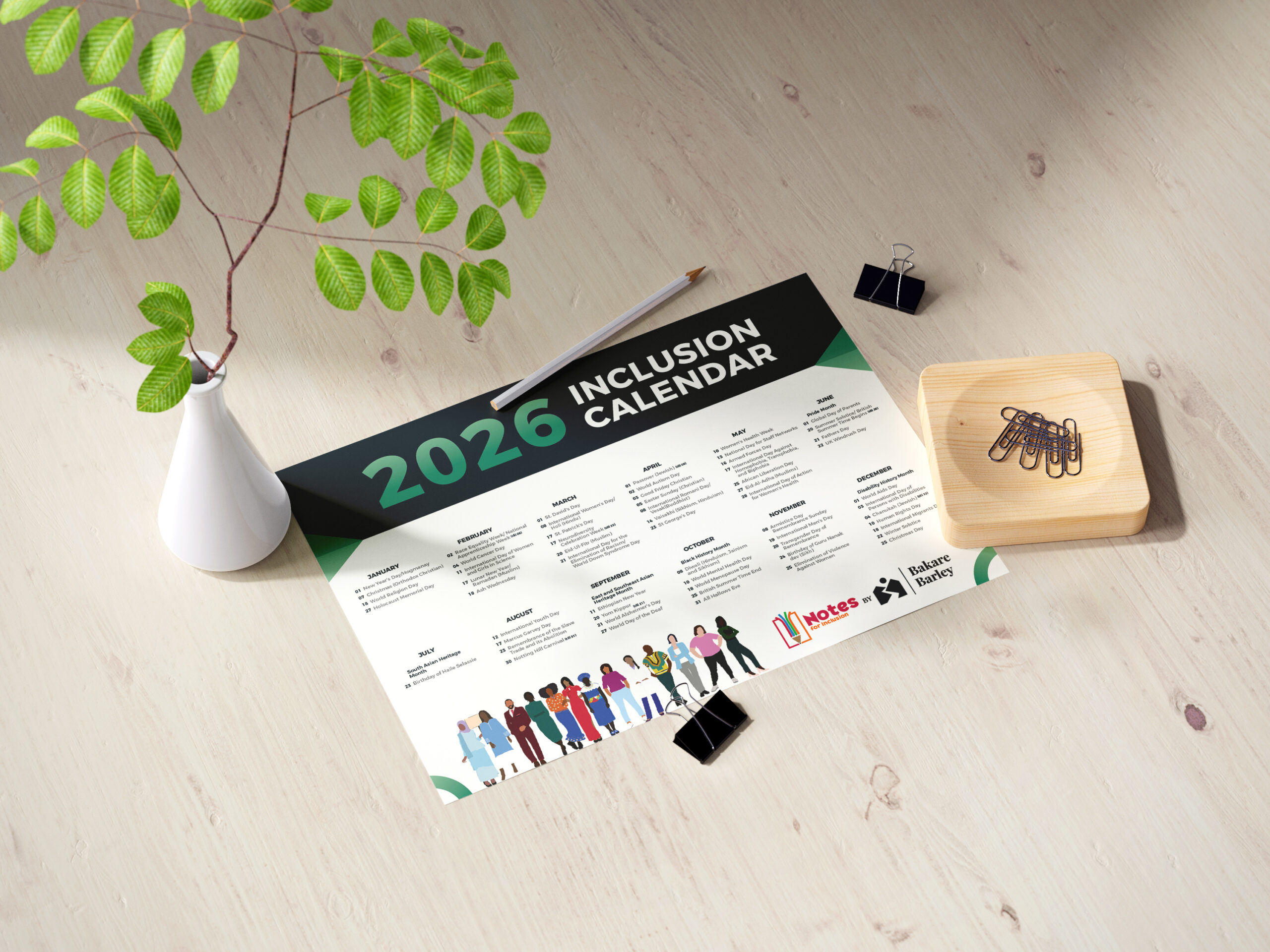
Walk into the offices of almost any UK public sector organisation, university, or charity in January and you will find, somewhere on a noticeboard or shared drive, a list of awareness days for the coming year. World Mental Health Day. Black History Month. International Women’s Day. Disability History Month. The list is long, and for many organisations, it is where inclusion planning begins and ends, a reactive, month-by-month scramble to post something on the intranet before the day passes.
An inclusion calendar is something fundamentally different. Used properly, it is not a list of awareness days to react to, it is a strategic planning tool that helps organisations be intentional, proactive, and genuinely inclusive in how they recognise, celebrate, and respond to the diversity of their workforce and the communities they serve throughout the year.
This guide explains what an inclusion calendar is, what it should contain, and most importantly how to use one effectively rather than performatively. Whether you are a HR lead in a local authority, an EDI officer in a university, or a senior manager in a nonprofit, this guide will help you understand why an inclusion calendar belongs at the centre of your inclusion planning and how to make it work in practice.
What Is an Inclusion Calendar?
An inclusion calendar, sometimes called a diversity calendar or EDI calendar, is a structured overview of the key dates, awareness events, cultural observances, religious festivals, and national campaigns that are relevant to equality, diversity, and inclusion throughout the year. It provides organisations with a forward-looking view of the inclusion landscape for the year ahead, enabling them to plan their communications, activities, training, and engagement in a way that is timely, considered, and genuinely respectful.
The best inclusion calendars go beyond a simple list of dates. They provide context for each observance, explaining its significance, its history, and why it matters in an organisational setting. They distinguish between the major national campaigns that most organisations will want to engage with publicly, the cultural and religious observances that are important to acknowledge respectfully, and the more specialist awareness days that may be particularly relevant to specific sectors or workforce compositions.
An inclusion calendar is not a compliance document. It is a planning and communication tool that is, when used well, helps organisations move from reactive awareness to proactive inclusion.
The difference between an organisation that uses an inclusion calendar well and one that does not is not which dates they mark, it is what they do with the time and intention that a calendar creates.
What Does an Inclusion Calendar Typically Include?
A comprehensive inclusion calendar for UK organisations covers several overlapping categories of dates and events. Understanding these categories helps organisations make more deliberate choices about which dates to engage with and how.
National EDI Awareness Campaigns
These are the high-profile, nationally recognised campaigns that generate the most public visibility and organisational engagement. They include events like National Inclusion Week in September, Black History Month in October, International Women’s Day in March, Mental Health Awareness Week in May, and Pride Month in June. These campaigns typically come with resources, toolkits, and organisational frameworks produced by the bodies that lead them, making them natural anchors for organisational activity.
Religious and Cultural Observances
A robust inclusion calendar acknowledges the major religious festivals and cultural observances that are important to staff and service users from different faith backgrounds and cultural communities. This includes Christian observances such as Easter and Christmas, Islamic observances such as Ramadan and Eid, Jewish observances such as Rosh Hashanah and Yom Kippur, Hindu observances such as Diwali and Holi, Sikh observances such as Vaisakhi and Gurpurab, and many others.
Acknowledging these dates respectfully and ensuring that organisational policies around leave, workload, and scheduling take them into account, is one of the most practical ways an organisation can demonstrate genuine inclusion.
Disability and Health Awareness Dates
Disability History Month, the International Day of Persons with Disabilities, World Mental Health Day, Neurodiversity Celebration Week, and a range of condition-specific awareness events fall into this category. For organisations committed to disability inclusion and to supporting staff wellbeing, these dates provide important opportunities for education, open conversation, and the signalling of organisational values.
Heritage and History Months
Black History Month in October, South Asian Heritage Month in July and August, LGBTQ+ History Month in February, and Gypsy, Roma and Traveller History Month in June are among the heritage and history months increasingly recognised by UK organisations. These months provide an extended period for deeper engagement, author talks, panel discussions, educational resources, community partnerships that goes beyond the single-day awareness format.
International Awareness Days
The United Nations and other international bodies designate awareness days for a wide range of social justice issues from International Day for the Elimination of Racial Discrimination to the International Day Against Homophobia, Biphobia and Transphobia.
Depending on the sector and the specific focus of an organisation’s EDI work, a selection of these international days may be relevant and worth incorporating into an inclusion calendar.
Why Your Organisation Needs an Inclusion Calendar
The case for an inclusion calendar is both practical and strategic. Here are the most compelling reasons why every public sector organisation, educational institution, and nonprofit should have one, and use it actively.
It enables proactive rather than reactive inclusion planning
Without a calendar, organisations tend to mark awareness days reactively, someone notices on the morning of World Mental Health Day that it has arrived, an internal communication is sent at short notice, and the opportunity for anything more meaningful has passed.
A calendar planned in advance creates the lead time needed to design activities that are thoughtful, properly resourced, and genuinely connected to the organisation’s wider inclusion goals.
It ensures that all staff feel seen and acknowledged
One of the most powerful signals an organisation can send to its staff is that their background, identity, and cultural heritage are known, valued, and respected, not just tolerated. An inclusion calendar that covers a genuine breadth of religious observances, heritage months, and awareness campaigns demonstrates that the organisation’s commitment to diversity goes beyond the most visible or majority groups. For staff from underrepresented communities, seeing their important dates acknowledged in the organisational calendar is a meaningful act of inclusion.
It supports HR and people planning
An inclusion calendar has a practical HR function beyond communications and events. When managers are aware of significant religious observances and cultural events in advance, they can plan workloads, meeting schedules, and leave allocations more equitably, avoiding the situation where staff have to repeatedly request adjustments at short notice and explain their significance. Forward planning on this dimension is a simple, high-impact way of making the workplace more equitable in day-to-day practice.
It creates a framework for consistent organisational communication
For communications teams and EDI leads, an inclusion calendar provides the structure needed to plan internal and external communications coherently across the year. Rather than a scattered, inconsistent approach to inclusion-related communications, a calendar enables a joined-up programme that builds audience familiarity, demonstrates sustained commitment, and avoids the awkward silences between awareness events that can undermine an organisation’s credibility.
It connects the dots between individual observances and strategic goals
Used strategically, an inclusion calendar does not just mark dates, it connects those dates to the organisation’s broader EDI strategy, action plan, and learning and development programme.
An organisation focused on race equity might use Black History Month to launch its anti-racism training programme, or use the International Day for the Elimination of Racial Discrimination to publish its workforce race data. This kind of strategic alignment transforms an inclusion calendar from a communications tool into a strategic driver of organisational change.
The Difference Between a Performative Calendar and a Strategic One
Not all uses of inclusion calendars are equal. The distinction between performative and strategic use of an inclusion calendar is one of the most important things an organisation can understand because performative use not only fails to advance inclusion, it can actively damage the credibility and trust that genuine inclusion requires.
What performative use looks like
Performative use of an inclusion calendar is characterised by surface-level engagement with awareness dates that is driven primarily by communications and reputation management rather than genuine organisational commitment. It looks like posting a rainbow logo during Pride Month while having no LGBTQ+ inclusion policies or staff network.
It looks like sharing a Black History Month social media post from an organisation that has never examined its own racial pay gap or addressed the underrepresentation of Black staff in leadership. It looks like acknowledging Eid Al-Fitr in an internal newsletter while having leave policies that make it impossible for Muslim staff to take the day off easily.
Staff from marginalised communities are acutely perceptive of this gap between what an organisation says publicly on awareness days and what the lived experience of belonging to that community inside the organisation actually is. Performative engagement does not go unnoticed. It generates cynicism, erodes trust, and often leaves staff from underrepresented groups feeling more invisible than they did before the organisation marked the date.
What strategic use looks like
Strategic use of an inclusion calendar connects each engagement to something real like a policy, a commitment, an action, a learning opportunity, or a genuine shift in organisational practice. It means using Black History Month to review and publish your race equity data and announce specific actions.
It means using Mental Health Awareness Week to launch a wellbeing support programme that your staff actually need. It means using National Inclusion Week to recommit to your EDI action plan with specific, time-bound goals and named accountability.
The test of strategic versus performative use is simple: could your organisation’s engagement with each awareness date be contradicted by evidence from inside the organisation? If the answer is yes, the engagement is performative. If the answer is no, if what you say publicly is matched by what staff experience internally, then you are using your inclusion calendar strategically.
An inclusion calendar used well is an accountability tool as much as a communications one. Every date you mark publicly is a commitment , to your staff, your service users, and yourself.
How to Use an Inclusion Calendar Effectively in the Public Sector
Public sector organisations operate under the Public Sector Equality Duty, which requires them to have due regard to equality, diversity, and inclusion in everything they do. An inclusion calendar provides a practical framework for demonstrating and delivering on this duty in a way that is visible, consistent, and connected to organisational strategy.
For public sector leaders and EDI officers, the most effective approach to an inclusion calendar combines three levels of engagement. At the organisational level, the calendar anchors the major national campaigns like National Inclusion Week, Black History Month, International Women’s Day to strategic initiatives: data publications, policy reviews, training launches, or action plan updates.
At the team level, managers are supported to use the calendar to have relevant conversations with their teams to check in about workload scheduling around religious observances, to facilitate team learning during awareness months, and to modelinclusive leadership behaviours consistently. At the individual level, staff are encouraged to engage with the calendar as a resource for their own learning and for understanding the experiences of their colleagues.
For local authorities, NHS trusts, and other public bodies, the inclusion calendar also has an external dimension, it provides a framework for communicating inclusively with the diverse communities they serve, ensuring that public-facing communications acknowledge the breadth of community identities and observances throughout the year.
How to Use an Inclusion Calendar in Educational Institutions
For schools, colleges, and universities, an inclusion calendar serves a dual purpose: it supports the inclusion of staff and the inclusion of students simultaneously and these two dimensions require different but complementary approaches.
For staff, the calendar functions in the same way as in any other organisation providing a framework for HR planning, internal communications, and professional development. For students, it provides a structure for the educational institution to demonstrate that the curriculum, campus culture, and community it offers genuinely reflects and values student diversity.
In schools, an inclusion calendar can underpin a whole-school approach to diversity education connecting assembly themes, PSHE content, library resources, and staff professional development to a coherent, year-round programme rather than a series of disconnected awareness day activities. In universities, the calendar provides a framework for student unions, EDI offices, and academic departments to coordinate their inclusion activities in a way that creates a coherent institutional message.
Ofsted and the Quality Assurance Agency both look for evidence of embedded inclusion practice in the institutions they inspect. An inclusion calendar that is genuinely integrated into institutional planning, rather than bolted on as an afterthought provides meaningful evidence of that practice.
How to Use an Inclusion Calendar in Voluntary Sector Organisations
For nonprofit and voluntary sector organisations, an inclusion calendar plays a particularly important role in demonstrating the alignment between stated values and internal practice. Many charities and voluntary organisations hold strong social justice values yet can be surprised to find that their internal culture does not always reflect those values as fully as their external communications suggest.
An inclusion calendar for the voluntary sector needs to balance breadth with depth. Rather than attempting to mark every possible awareness date, the most effective approach is to select the dates most relevant to the organisation’s mission and workforce composition, and to engage with those dates in a way that is genuinely substantive connecting them to staff learning, community partnerships, and organisational self-reflection.
For organisations that work directly with marginalised communities, the inclusion calendar also has a programmatic dimension, it provides a framework for ensuring that the communities you serve are acknowledged, celebrated, and centred in your work throughout the year, not only during headline awareness events.
Common Mistakes Organisations Make With Inclusion Calendars
Even well-intentioned organisations make avoidable mistakes in how they use inclusion calendars. Here are the most common ones, and what to do instead.
- Trying to mark every single date: An inclusion calendar with 200 awareness days is not more inclusive than one with 40, it is more exhausting, and it dilutes the impact of every engagement. Be selective and intentional. Choose the dates that are most relevant to your workforce, your service users, and your strategic EDI priorities, and engage with them properly rather than acknowledging everything superficially.
- Treating the calendar as a communications responsibility rather than an organisational one: When the inclusion calendar lives only in the communications team, it produces social media posts and newsletter items but rarely anything more substantive. The calendar should be owned and used across the organisation by HR, by learning and development, by managers, and by senior leaders, not just by comms.
- Failing to consult staff on which dates matter most to them: The most meaningful inclusion calendars are built with input from the workforce rather than imposed from above. Ask your staff networks, your EDI champions, and your colleagues from underrepresented groups which dates are significant to them, and let that input shape your priorities.
- Using the calendar without addressing the underlying culture: Marking Disability History Month publicly while having inaccessible office spaces, inadequate reasonable adjustment processes, or a culture where disabled staff feel unable to disclose is worse than not marking it at all. An inclusion calendar works only when it reflects a genuine organisational commitment to the groups it acknowledges.
- Not planning far enough in advance: Meaningful engagement with awareness dates requires planning time for designing activities, securing speakers, creating resources, and communicating with staff. An inclusion calendar that is reviewed quarterly rather than annually will consistently produce last-minute, under-resourced engagement. Plan for the full year in January, and revisit quarterly to refine.
How an Inclusion Calendar Connects to Your Wider EDI Strategy
An inclusion calendar is most powerful when it is not a standalone document but an integrated component of a broader EDI strategy. The relationship between the two should be explicit and intentional: your EDI strategy sets the direction and the goals, and your inclusion calendar provides the year-round structure of touchpoints, learning moments, and accountability milestones that keep the strategy alive in day-to-day organisational life.
Concretely, this means aligning your calendar engagements with your strategic priorities. If your EDI strategy has a specific focus on race equity this year, your inclusion calendar should reflect that with International Day for the Elimination of Racial Discrimination, Black History Month, and National Inclusion Week all connected to your race equity commitments and actions.
If your strategy prioritises disability inclusion, Disability History Month and the International Day of Persons with Disabilities become strategic moments for publishing data, launching initiatives, or reviewing policies.
This alignment also means that your inclusion calendar becomes an accountability structure, a visible, time-bound sequence of moments at which your organisation’s progress against its EDI commitments is demonstrated publicly. That accountability is good for your staff, good for your service users, and good for your organisation’s long-term credibility as a genuinely inclusive institution.
We have created a comprehensive 2026 Inclusion Calendar specifically designed for UK public sector organisations, educational institutions, and nonprofits. It covers all the major national EDI campaigns, religious and cultural observances, heritage months, and international awareness dates that are most relevant to organizations committed to genuine inclusion.
The calendar includes context and guidance notes for each key date, helping your team understand the significance of each observance and how to engage with it in a way that is respectful, informed, and genuinely meaningful for your staff and service users.
An Inclusion Calendar Is a Starting Point, Not a Destination
An inclusion calendar is one of the most accessible and practical tools available to organisations that are serious about building inclusive cultures. It does not require a large budget, a dedicated EDI team, or an advanced level of organisational maturity. What it requires is intentionality the decision to plan proactively rather than react, to consult rather than assume, and to connect public acknowledgement of diversity to genuine internal action.
Used well, an inclusion calendar transforms the way an organisation relates to the diversity of its workforce and its communities throughout the year. It creates moments of connection, learning, and celebration that build belonging over time. It provides an accountability structure that keeps EDI commitments visible and alive between the major strategy reviews and annual reports. And it signals, consistently and publicly, that the organisation’s commitment to inclusion is not seasonal, it is year-round.
Download Bakare Barley’s 2026 Inclusion Calendar to get started and if you would like support connecting your calendar to a broader EDI strategy that creates lasting change, we would love to have a conversation.
Want support building an EDI strategy around your inclusion calendar?
Bakare Barley works with public sector organisations, educational institutions, and nonprofits to develop evidence-based EDI strategies, inclusive leadership programmes, and training that creates real, lasting change. Book a free 30-minute consultation with Ayo Barley today.